Measure 3
Candidate Competency at Program Completion (R3.3, RA3.4) - Initial Programs Candidate Preservice Assessment of Student Learning (CPAST) for Academic Year 2024-2025
This CAEP Accreditation Measure is also available online as a Microsoft Word document
Background
SIUC began using the Candidate Preservice Assessment of Student Learning (CPAST) to assess student teachers in 2018. The CPAST is administered at mid-term and final evaluation conferences between the clinical supervisor, cooperating teacher, and teacher candidate. The CPAST is aligned to the edTPA, CAEP, and InTASC standards.
The CPAST Form was created as part of the Valid and Reliable Instruments for Educator Preparation Programs (VARI-EPP) Project. VARI-EPP is a group of Ohio EPPs who have collaborated since 2014 to develop instruments that meet CAEP accreditation requirements.
The CPAST assessment has two subscales: Pedagogy (13 rows) and Dispositions (8 rows). The CPAST Pedagogy assesses a student teacher’s pedagogical knowledge/skills as demonstrated in student teaching. The CPAST Dispositions assesses the professional dispositions of a student teacher, including behaviors toward students and other stakeholders, professionalism, and professional development.
Quality Assurance
According to the CPAST Handbook, valid data from 1,203 teacher candidates from 23 EPPs in Ohio were collected during the academic year of 2015-2016. Of the 1,203 teacher candidates, 32 were recruited to participate in the inter-rater reliability study, in which each teacher candidate was evaluated by two supervisors – their primary university supervisor (i.e. the supervisor who was formally assigned by the EPPs to supervise the teacher candidate during the student teaching), and a secondary rater (i.e. a supervisor who completed a minimum of three observations of the teacher candidates throughout the semester). Analyses were performed on the CPAST Form regarding validity (content, construct, and concurrent) as well as reliability (internal consistency, inter-rater reliability) and met standards for instrument development. SIUC Clinical Supervisors and Cooperating Teachers participate in annual training sessions to ensure continued reliability.
Criteria For Success
The CPAST contains four performance levels: (3) Accomplished, (2) Proficient, (1) Developing, (0) Unacceptable. Educators are encouraged to use the CPAST as a coaching tool and as such, no particular “cut” score was recommended. For SIUC initial programs, a 2.0 mean target was set for all elements as a unit-wide benchmark, and those below become areas of focus.</p?
Support Improvement
At the Program Improvement and Assessment Committee meetings, program coordinators and clinical supervisors analyze CPAST trends over time and make comparisons of data across programs. Once areas of strength and areas for improvement are identified, recommendations are brought to the appropriate stakeholders to be discussed and implemented.
Unit Results
CPAST items A-U are the focus elements for meeting the performance levels. The chart below is divided into content areas of each candidate demonstrating the final data point of each CPAST item. As a unit all candidates exceeded the benchmark percentage which is set at 80% with most candidates scoring between 88%-100% in the CPAST items.
CPAST Performance Levels
SPRING 2025 CPAST DATA BY PROGRAM 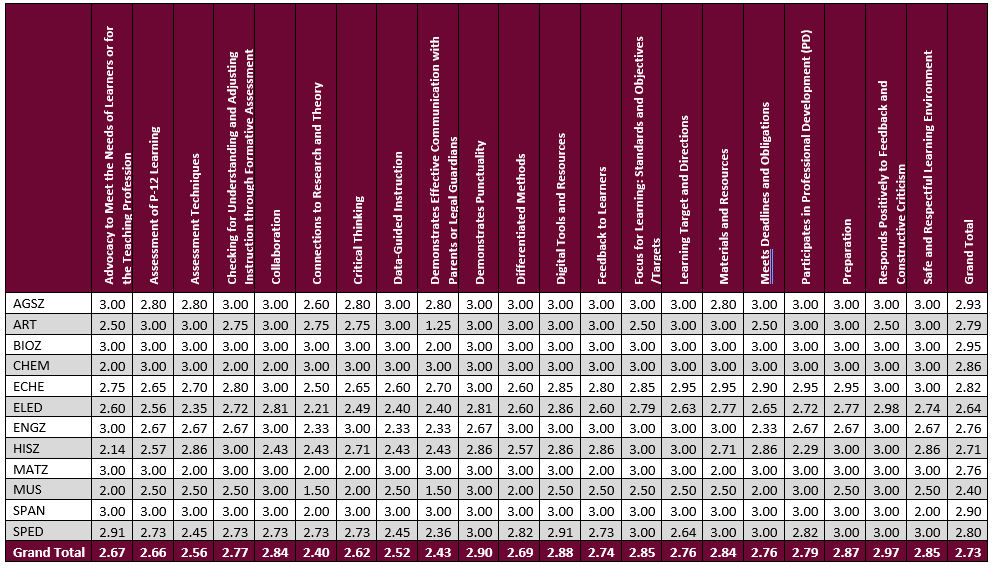
CPAST Alignment Chart
|
CPAST Category |
CPAST Item |
edTPA Rubric |
InTASC/CAEP Standard |
|
Planning for Instruction and Assessment |
A. Focus for Learning: Standards and Objectives/Targets |
1, 4 |
7a |
|
B. Materials and Resources |
2 |
7b |
|
|
C. Assessment of P-12 Learning |
5 |
6b |
|
|
D. Differentiated Methods |
3, 4, 7, 11 |
2c |
|
|
Instructional Delivery |
E. Learning Target and Directions |
1, 9 |
7c |
|
F. Critical Thinking |
7, 8, 9 |
5d |
|
|
G. Checking for Understanding and Adjusting Instruction through Formative Assessment |
8, 10 |
8b |
|
|
H. Digital Tools and Resources |
5, 9 |
CAEP 1.5 |
|
|
I. Safe and Respectful Learning Environment |
6 |
3d |
|
|
Assessment |
J. Data-Guided Instruction |
10, 11, 14, 15 |
CAEP 2.3 |
|
K. Feedback to Learners |
12, 13 |
6d |
|
|
L. Assessment Techniques |
5 |
7d |
|
|
Analysis of Teaching |
M. Connections to Research and Theory |
3, 10, 15 |
CAEP 1.2 |
|
Professional Commitment and Behaviors |
N. Participates in Professional Development |
||
|
O. Demonstrates Effective Communication with Parents or Legal Guardians |
10d |
||
|
P. Demonstrates Punctuality |
9o |
||
|
Q. Meets Deadlines and Obligations |
9o |
||
|
R. Preparation |
3d |
||
|
Professional Relationships |
S. Collaboration |
6, 10, 15 |
10b |
|
T. Advocacy to Meet the Needs of Learners or for the Teaching Profession |
3, 15 |
10j |
|
|
Critical Thinking and Reflective Practice |
U. Responds Positively to Constructive Criticism |
10, 15 |
9n |