Measure 2
Satisfaction of Employers & Stakeholders Involvement (R4.2|R5.3|RA4.1) - SIUC Employer Satisfaction Survey for Initial Programs
This CAEP Accreditation Measure is also available online as a Microsoft Word document
Background
In 2018, SIUC created the Employer Satisfaction Survey to be completed each spring semester by the principals of our completers throughout the region. Since SIUC does not receive information from ISBE about where completers are employed, a link is sent by email to the principals of our recent graduates (6 months to 3 years).
Criteria of Success
The ratings on this survey are as follows: extremely satisfied, very satisfied, moderately satisfied, somewhat satisfied, and not very satisfied. These “scaled choices have been qualitatively defined using specific criteria aligned with key attributes” (CAEP, 2017) rather than using a numbered scale.
Quality Assurance
The questions on this survey use direct language from the Illinois Professional Teaching Standards (IPTS) with which administrators are very familiar. The questions are also aligned to InTASC standards. While we did not conduct a pilot of these questions with administrators, these questions are directly from our Pre-Student Teaching Clinical Evaluation Rubric elements. We consulted a panel of experts in developing the rubric, conducted a pilot, and established inter-rater reliability in Fall 2017. We made modifications, as necessary, to the rubric before creating the survey in spring 2018. In addition, the questions on this survey are the same as the questions asked on the completer follow-up survey and candidate exit survey in order to make comparisons between employer satisfaction and completer confidence at graduation and as an in-service teacher.
Support For Improvement
The Employer Satisfaction Survey is administered electronically and anonymously by SIUC. This method allows the unit to analyze data trends systematically with program coordinators, clinical supervisors, and local stakeholders.
Results And Analysis
Due to the Covid 19 Pandemic, the survey was not administered for the 2020 nor the 2021 Cycle. School administrators were understaffed, and most schools were operating remotely. Data collection resumed spring 2022, but halted again in Spring 2024 and 2025 due to staffing changes.
In 2022, five administrators completed the employer satisfaction survey while reflecting upon the performance of eight teachers who graduated from SIU within the last three years. The average ratings indicated that all areas were at 80% and above with the highest average ratings at 92% which indicated the employers were extremely satisfied in their employees’ ability to create a positive learning environment, to develop and maintain collaborative relationships, and to participate in professional dialogue and continuous learning. The lowest average ratings (84%) by employers indicated the employers were less satisfied with their teachers’ ability to appropriately use a variety of informal and formal assessments to evaluate the understanding, progress, and performance of the individual student and the class as a whole.
In 2023, eight administrators completed employer satisfaction survey while reflecting upon the performance of thirteen teachers who graduated from SIU within the last three years. The employer satisfaction ratings were between 70% and 80% in all areas. The highest average ratings pertained to the teachers’ abilities to create short-range and long-term plans (70%) and to create a positive learning environment (80%). The lowest average ratings indicated employers were less satisfied with the teachers’ abilities to participate in professional dialogue and continuous learning, as well as to appropriately use a wide variety of assessments.
*The low return rate on these surveys each year makes it difficult to generalize findings that can be useful for future programming.
Employer Satisfaction Survey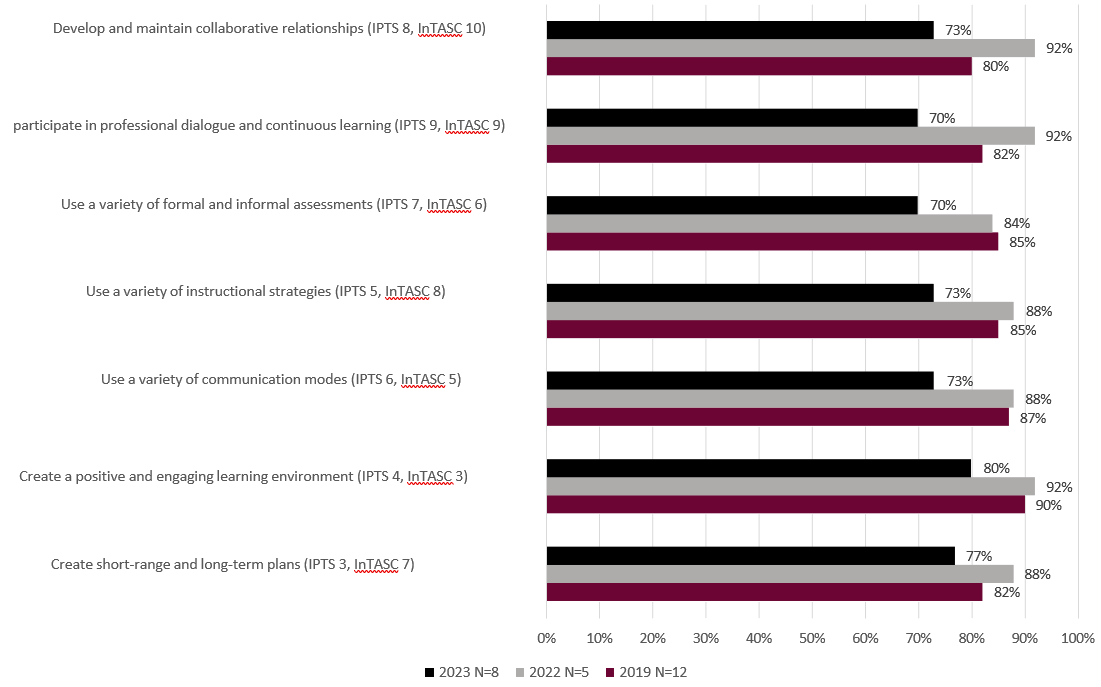
|
Standard |
2019 (N=8) |
2022 (N=5) |
2023 (N=12) |
|
Develop and maintain collaborative relationships (IPTS 8, InTASC 9) |
80% |
92% |
73% |
|
Participate in professional dialogue and continuous learning (IPTS 9, InTASC 9) |
82% |
92% |
70% |
|
Use a variety of formal and informal assessments (IPTS 7, InTASC 6) |
85% |
84% |
70% |
|
Use a variety of instructional strategies (IPTS 5, InTASC 8) |
85% |
88% |
73% |
|
Use a variety of communication models (IPTS 6, InTASC 5) |
87% |
88% |
73% |
|
Create a positive and engaging learning environment (IPTS 3, InTASC 7) |
90% |
92% |
80% |
|
Create short-range and long-term plans (IPTS 3, InTASC 7) |
82% |
88% |
77% |